With over 35 years of experience in the design and print industry, we’ve encountered a wide array of print-related terminology that can often leave clients puzzled. To help clarify some of these terms, we’re starting a series of informative blog posts about different types of print processes and lingo. In our first post, we’re diving into one of the most common bookbinding methods: Saddle Stitching.
What Does “Saddle Stitch” Mean?
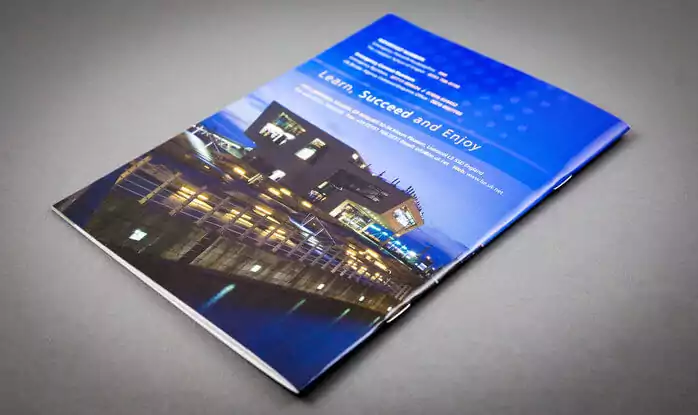
In the printing industry, saddle stitching refers to a traditional bookbinding technique. It’s most effective for smaller publications, such as brochures, booklets, and catalogues, typically containing no more than 72 pages (depending on the thickness of the paper stock). The process involves gathering folded sheets of paper and securing them along the folded spine with metal staples. The staples pass through the outer folded sheets and are fastened between the centre pages, typically using two staples. For larger brochures, more staples may be added for additional stability.
Why Is It Called “Saddle Stitching”?
Despite involving staples, the term “saddle stitching” makes perfect sense to those familiar with the print industry. In printing, “stitching” is a common term used for stapling. The term “saddle” comes from the saddle-like apparatus over which the sheets are draped during the stapling process. Thus, the name “saddle stitching” was born.
How Does the Saddle Stitch Process Work?
To better understand this process, imagine you’re creating an A4-sized saddle-stitched brochure. The finished page size is 210mm x 297mm (standard A4 size), but the sheets of paper begin as 297mm x 420mm (A3 size). These larger sheets are folded in half, creating the A4 size. The folded sheets are stacked inside one another, with the staples placed along the folded crease—this becomes the spine of the booklet.
Each folded sheet creates four pages of the A4 brochure, which is why it’s essential to work in multiples of four when designing saddle-stitched brochures. After the inner pages and cover are printed and partially folded, the entire booklet is stapled together along the spine. To finish, the edges opposite the spine are trimmed to ensure the booklet’s pages align neatly, as inner pages tend to stick out slightly due to the thickness of the paper. This trimming enhances the appearance of the final product.
What Types of Brochures Use Saddle Stitching?
Over the years, we’ve saddle-stitched a wide range of printed materials, including Premier League football programmes, charity calendars, educational brochures, and smaller catalogues. This versatile and cost-effective binding method is ideal for shorter publications where keeping costs low and presentation high is important.
General Guidelines for Saddle Stitching
Saddle stitching is the most efficient binding method for publications with fewer than 72 pages. However, if a thicker paper stock is used, the number of pages may need to be reduced to ensure the booklet lies flat. If your publication exceeds 72 pages or is printed on heavier stock, we recommend perfect binding as an alternative. While perfect binding is more costly, it offers a sleek, professional finish—something we consider the “crème de la crème” of brochure binding.
Need Help with Brochure Design or Printing?
If you’re unsure which binding method is best for your project, or if you need assistance with brochure design and printing, don’t hesitate to contact us. Our team at NW Design is always happy to help. With decades of experience, we can guide you through the process and ensure your final product meets your needs and exceeds your expectations. Give us a call today on 0161 327 2131.